The first thing to do is realize why you smoke. Then, you must think of all the reasons why you should not smoke. If you really try and perhaps write them out on paper, you could think of dozens of good reasons why you should not smoke.
What are some of the reasons? First, of course there is the threat of lung cancer or other fatal diseases; also the nonsmoker has more energy and vitality to enjoy life; his mind can function better; he save money. Other reasons to quit are to prove you have willpower; to setthe right example for your children.
You know what, when you stop smoking, your food will taste better. Your throat won't be continually clogged with phlegm. You will get rid of the hacking cigarette cough. Actually, you will gradually begin to feel much less nervous, even though that may seem hard to believe. The first few days after you quit, you might feel more nervous but gradually the nervousness will diminish and you will be calmer and more poised.
Remember, smoking is actually a "crutch" to many people. It helps them "escape" stress, strain and tension. Smoking is one of the channels of escapism available to people today but which has a fatal kickback ( a deadly boomerang effect on the smokers!).
When you quit smoking, you will begin to enjoy life much more. This is fact!! Breathing fresh air will be a pleasure; smelling the wonderful odors of nature will tantalize your olfactory nerves. You will sleep better. No more danger of accidents or fire in bed. No more ugly cigarette butts lying around the house. When you wake up in the morning, you will begin to feel like a NEW MAN or a NEW WOMAN! You will have a feeling of intense satisfaction and pleasure and freedom from the slavery of the tobacco habit. Your life will be healthier, happier, more joyful and abundant.
All these things will become yours after you conquer and kick the cigarette habit. Some of these blessings will come gradually. Some will become apparent very soon. Think of these benefits from not smoking. Think of the gruesome cost of smoking. Form in your mind the strong desire, motivation and resolve to quit smoking! Do these things and you will have made a good beginning in stopping smoking. But there is more that you mustdo, if you want to make sure that you completely overcome the vile, noxious habit.
In order to conquer the smoking habit, you must be willing to face up to the real reason why you smoke. Dr. Daniel Horn, director of the National Clearinghouse for Smoking and Health, took a survey of some 5,000 smokers to uncover the reasons they smoked. He found that 10 percent used cigarettes as a stimulant, while 8 percent simply enjoyed lighting and handling a cigarette. From 30-40 percent used smoking to achieve a pleasant form of relaxation. Another 40-50 percent smoked to relieve anxiety and tension. Many of these, he found, go on to become addicted chain smokers!
The last category of smokers is the one finding smoking the most difficult to give up! Forty percent of smokers are "heavy smokers" (they are compulsive smokers!). For them quitting is not easy.
Do you really want to enjoy life, its riches, thrills and delights? Do you want to appreciate tantalizing aromas, the biting, crisp smell of fresh air, the spicy scents of nature? Then stop smoking! Give your lungs a chance to repair themselves.
An astonishing thing happens when people stop smoking. Lung damage is reversed when men and women stop smoking. Body defenses come into play and destroy pre-cancerous cells! The lungs gradually turn pink again. But just one or two cigarettes a day prevents the healing process and so does switching to pipes or cigars.
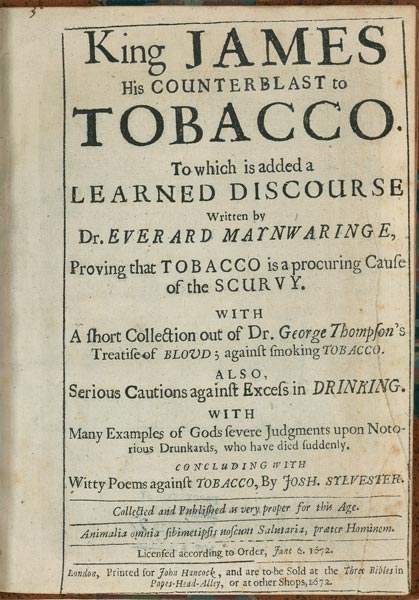
In 1604 James I, King of England published his famous Counterblast to Tobacco. He concluded the treatise by calling smoking "a costume lothsome to the eye, hatefull to the nose, harmefull to the braine, daungerous to the lungs and in the blacke stinking fume thereof, nearest resembling the horrible Stigian smoke of the pit that is bottomeless."
A colourful description, no doubt, But today smoking has been proved beyond the shadow of a doubt to be loathsome, harmful, dangerous to the lungs - a serious public health menace!
Do you know that about 21 million people have successfully quit smoking? But how?? Where can you get the necessary strength, fortitude and willpower? Let's admit the truth. All kinds of gadgets, gimmicks, potions and medicines have come on the market purporting to help the smoker quit smoking. I think none of them has proved 100% effective!! To me , gimmickry and gadgetry are not the answer. Pills, drugs, candy, chewing gum are not the answer. All these remedies miss the heart and core of the problem - the SMOKER HIMSELF and HIS ATTITUDE!!
I understand that smoking is probably the hardest, among human being's bad habits, to get rid off. Do you know about electronic cigarettes? I don't believe that this is a good way for you to quit. The fact is, I never tried it before so I can't comment any further either it works or not.
"E-cigarettes were invented by Hon Lik of electronics company Ruyan in Beijing, China. Ruyan sold its first electronic cigarette in May 2004, and e-cigarettes have been growing in popularity ever since. Accurate figures are hard to come by, but Ruyan - the world's biggest manufacturer - claims to have sold over 300,000 in 2008. Smart Smokers, one company which sells Ruyan's cigarettes in the UK, says sales are rising exponentially. In the US, hit TV show The Doctors featured the e-cigarette in the top 10 health trends of 2008. In a world where smoking is increasingly socially unacceptable, the e-cigarette looks like a success story in the making.
It is believed that these electronic smoking products will change greatly the whole life of the world in the future, and these words or expression are becoming and will become more and more popular in the every day's life of the world. So far so good. But are e-cigarettes really less harmful than the real thing? Have you tried it? What do you think about it?
Below is some of a Quit Smoking Tip Sheet. If you want to add yours, never hesitate to leave a comment. Let's help each others.
1- Quit cold turkey. In the long run it's the easiest and most effective technique of smoking cessation.
2- Do not carry cigarettes.
3- Quit smoking one day at a time. Do not concern yourself with next year, next month, next week or even tomorrow. Concentrate on not smoking from the time you wake up until you go to sleep.
4- Work on developing the attitude that you are doing yourself a favor by not smoking. Do not dwell on the idea that you are depriving yourself of a cigarette. You are ridding yourself of full-fledged smoking because you care enough about yourself to want to.
5- Be proud that you are not smoking.
6- Be aware that many routine situations will trigger the urge for a cigarette. Situations which will trigger a response include: drinking coffee, alcohol, sitting in a bar, social events with smoking friends, card games, the end of meals. Try to maintain your normal routine while quitting. If any event seems too tough, leave it and go back to it later. Do not feel you must give up any activity forever. Everything you did as a smoker, you will learn to do at least as well, and maybe better, as an ex-smoker.
7- Make a list of all the reasons you want to quit smoking. Keep this list with you, preferably where you used to carry your cigarettes. When you find yourself reaching for a cigarette, take out your list and read it.
8- Drink plenty of fruit juice the first three days. It will help flush nicotine out of your system.
9- To help avoid weight gain, eat vegetables and fruit instead of candies and pastries. Celery and carrots can be used safely as short-term substitutes for cigarettes.
10- If you are concerned about weight gain, do some moderate form of regular exercise. If you have not been exercising regularly, consult your physician for a practical exercise program which is safe for you.
11- If you encounter a crisis, (e.g. a flat tire, flood, blizzard, family illness) while quitting, remember, smoking is no solution. Smoking will just complicate the original situation while creating another crisis, a relapse into the nicotine addiction.
12- Consider yourself a "smoke-a-holic." One puff and you can become hooked again. No matter how long you have been off, don't think you can safely take a puff!
13- Don't debate with yourself how much you want a cigarette. Ask yourself how do you feel about going back to your old level of consumption. Smoking is an all or nothing proposition.
14- Save the money you usually spend on cigarettes and buy yourself something you really want after a week or a month. Save for a year and you can treat yourself to a vacation.
15- Practice deep breathing exercises when you have a craving.
16- Go places where you normally can't smoke, such as movies, libraries and no smoking sections of restaurants.
17- Tell people around you that you have quit smoking.
About 90 million people in the United States smoke, in one form or another. An estimated four million teenagers join the ranks of the smoker every year. There are an estimated seven million who smoke two packs a day ( about four percent of the adult population.
When do people start smoking?
Actual data suggests that few children begin smoking before age 12 - less than five percent of the boys and one percent of the girls, probably. From age 12, however, smoking gradually increases. At the 12th-grade level, between 40 and 55 percent of children have been found to be smokers. By age 25, estimates run as high as 60 percent of men and 36 percent of women.
Doctors estimates that 10 percent of later smokers begin to become regular smokers before their teens and65 percent during their high school years. Is it any wonder then that many cigarette comercials seem to feature youth, vitality, excitement, fun and those things which are attractive to young people in particular?
Recently I read about the electronic cigarette called Green Smoke and I found that its quite interesting devices that smokers should try. It is a new nicotine smoking device which provides a healthier alternative to cigarettes without thousands of unwanted, unnecessary chemicals and carcinogens. With the Green Smoke, there is no need to light. Just pull it out and start puffing and you will immediately enjoy the same nicotine, but you will be healthier and, by the way, wealthier! Check out video below.
Computations reveal that for every dollar spent on tobacco, another dollar plus must be spent for cigarette induced disease or is lost due to missing work because of smoking. In 1967 about $9 billion were spent on tobacco in the U.S. In that same year, an estimated $11 billion were lost to the American economy because of cigarette deaths, disease and lost workdays! Therefore, when you total it all up, smoking amounts to at least a twenty billion dollar swindle yearly per petrated upon the naive, gullible American public! Is it worth it??
Over a million people in the United States are forced to lead restricted lives because of emphysema. It incapacitates 1 out of 14 wage earners over 45. A study of British physicians showed the death rate for bronchitis and emphysema for those who smoked 1 -14 cigarettes a day was 6.8 times as high as that for nonsmokers; those who smoked 25 or more cigarettes a day suffered 21 times as many deaths from these causes as nonsmokers!
All in all, today there are about 11 or 12 millions more cases of chronic illness yearly in the United States due to smoking. But isn't it strange - sort of gruesomely macabre in a way? If a doctor developed a vaccine that would prevent lung cancer and protect you from emphysema, bronchitis and heart disease you know that there would be a maddening stampede by millions to be inoculated with it. But even better than such a vaccine would be a simple step - "just stop smoking! How many would take it??
Anyway you slice it , anyway you look at it, smoking is costly. It is one of the most costly habits you could have! The average smoker spends around $14,000 in his lifetime on the smoking habit. A person smoking two packs of cigarettes a day spends upward of $400 a year on his habit - or $4,000 in ten years, $8,000 in twenty years and $20,000 in fifty years of his smoking "lifetime". Think about it!! Can you really afford to smoke, when you add up all the costs, expenses for cigarettes, medical bills, decreased efficiency, increased nervousness, chronic illness and ultimately perhaps terminal cancer??
Smoking is claimed to be the number one preventable cause of disease. Yet, despite dire warnings, millions continue to puff away. Smoking advocates claim it is pleasing the senses, enjoyable and fun. They claim it is relaxing, restful and refreshing. Some even insist that smoking is harmless!
Chemistry of Smoking
Some 4000 different chemical compounds have been identified in tobacco smoke. Do you know that one puff of cigarette smoke contains 15 billions particles of matter? Among them are many of the most noxious substances known to man! Here is a partial list : Nicotine, pyridine, methyl alcohol, ammonia, carbon monoxide, furfural, formaldehyde, cancerogenic benzopyrene, phenols, acetone, arsenic, acids such as formic, oxalic, citric, acetic, coffeic, hydrocyanic.
Nicotine is one of the quickest, most fatal poisons known. A fatal dose is about 100 miligrams - about one cigar contains. If 500 miligrams of nicotine were directly injected into the bloodstream, the person would be killed instantly!
Tobacco "tars" of course, have been linked with cancer. They are carcinogenic. Tars are formed during the heating of the tobacco leaf. If a mouthful of smoke is blown through a handkerchief, a brown, malodorous stain can be seen ( evidence of the tars ).
A smoker who uses about a pack and a half of cigarettes a day inhales into his mouth, pharynx, larynx and lungs about a QUART of tobacco tar in a year!!
Benzopyrene is one of the most powerful known cancer causing agents in animals. Arsenic is another cancer causing chemical found in cigarettes. A man who smokes a pack a day may take as much as 36 miligrams of arsenic into his body every year from smoking alone. The arsenic comes from lead arsenate, used as a pesticide on tobacco plants.
Every time a smoker smokes, these chemicals invade his system. One of the chemicals called "collidine" is used for killing experimental animals. It causes paralysis and death. Another on called "prussic acid" can kill within minutes. Methyl alcohol causes first blindness, then death. Formaldehyde is used by morticians for embalming dead bodies. Tobacco has an arsenic content 50 times the amount legally permitted in food.
If you have any questions, suggestions or articles that you would like to share and see in http://blog.smokingnomore.info, please let me know by filling this form. You can also use this feedback form to report broken links, updates or any other problems you encountered while using it. Thanks.